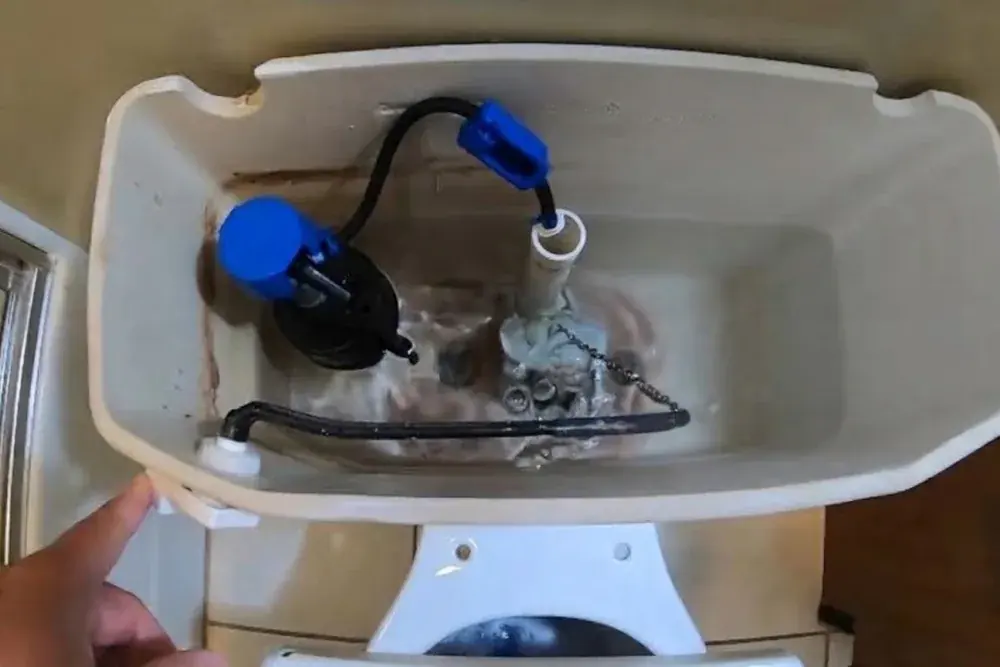
Where a Leaking Toilet Is Usually Leaking From
Start by deciding whether the water is coming from the base, the tank or the small hose behind the bowl. Water around the base only when you flush points to the wax ring or the closet bolts. Water running down the outside of the tank points to the tank bolts or the tank to bowl gasket.
A wet connection at the wall or floor valve means the supply line or shutoff valve. A toilet that never drips but keeps running or refilling is leaking inside, from the bowl to the drain, and that wastes water you never see.
Dry every surface first with a towel, then press a strip of toilet paper against each joint and flush. The paper that darkens first shows you the source.
Toilet Leak Symptoms and What They Mean
Use this table to match what you see with the most likely cause. It also shows which fixes are reasonable for a careful homeowner and which are better left to a plumber.
| What you see | Likely cause | Reasonable DIY step | Call a plumber if |
|---|---|---|---|
| Water pools at the base after a flush. | Failed wax ring or loose closet bolts. | Snug the bolts gently by hand wrench, a little at a time. | Water returns, the toilet rocks, or the floor feels soft. |
| Drips from the tank bottom bolts. | Worn rubber washers on the tank bolts. | Replace the washers with the tank shut off and drained. | The tank is cracked or the bolts are corroded in place. |
| Drips from the wall or floor valve. | Loose supply line nut or worn valve stem. | Tighten the nut a quarter turn and replace the line. | The shutoff valve will not close or leaks at the stem. |
| Tank refills every few minutes. | Flapper not sealing. | Replace the flapper and check the chain length. | The flush valve seat is pitted or cracked. |
| Water keeps running into the bowl. | Fill valve not shutting off. | Adjust the float or swap the fill valve. | Water level stays high after a new valve. |
| Sweating on the outside of the tank. | Condensation, not a leak. | Run a bathroom fan and check humidity. | Dampness continues with the tank dry inside. |
Sweating is the one case that looks like a leak and is not one. If the tank wall is cold and wet in humid weather but nothing drips from a joint, you are looking at condensation.
Toilet leaking onto the floor?
Shut the supply valve behind it, then call. We will tell you whether it is a quick part swap or a seal that needs more.
How to Check for a Toilet Leak Safely
These five steps cost nothing and take the guesswork out of the repair. Stop at any step where something feels stuck, corroded or unsafe.
Shut off the water
Turn the oval handle on the supply valve clockwise until it stops. Flush once to empty the tank and keep a towel nearby for the last of the water.
Dry everything
Wipe the tank, bowl, supply line and floor completely dry. A damp surface hides the real source and sends you after the wrong part.
Run the paper test
Press dry toilet paper against the base, tank bolts and supply connections. Turn the water back on, let the tank fill, flush, and see which strip darkens first.
Test the flapper with dye
Put a few drops of food coloring in the tank and wait twenty minutes without flushing. Color in the bowl means the flapper or flush valve seat is leaking.
Make one change at a time
Replace or tighten a single part, then retest. Changing three things at once leaves you guessing which one worked.
Why the Base Leaks and Why a Bolt Is Rarely the Fix
A toilet sits on a wax ring that seals the bowl to the drain flange in the floor. When that seal fails, wastewater seeps out every time you flush. The water is not clean, and it soaks the subfloor where you cannot see it.
Tightening the closet bolts is the first thing most people try. A small adjustment can help on a toilet that has loosened over the years, but forcing the nuts cracks the porcelain base. If the toilet rocks at all, or the leak returns after a snug fit, the ring has failed and the toilet needs to come up.
Resetting a toilet means shutting off the water, removing the tank connection, lifting a heavy bowl, scraping the old wax and setting a new ring on a clean flange. A damaged or low flange can keep a new ring from sealing, which is why a repair that looks simple sometimes needs a second part. Our toilet repair service covers resets, flange work and fill valve swaps.
Standing water on a bathroom floor is easy to spot and mop up. A slow seep at the base is worse, because it travels under the vinyl or tile and into the subfloor. Soft flooring, a stained ceiling below or a musty smell near the toilet usually means the leak has run for weeks.
If the ceiling under a bathroom is bulging or dripping, keep everyone out of that room below and turn off power to any light fixture there at the breaker before touching anything. Water and electricity share that space more often than people expect.
What to Have Ready for a Plumber
A few details save time on the phone and help the plumber bring the right parts.
- Where the water appears: base, tank bolts, supply line or the wall valve.
- Whether it leaks only when flushed or all the time.
- Whether the toilet rocks, even slightly, when you sit on it.
- Whether the shutoff valve closes fully and stops the water.
- The age of the toilet if you know it, and whether a floor or ceiling below looks stained.
- A photo of the base and the tank label, which shows the model.
If you cannot get the shutoff valve to close, the main water valve for the house is the next stop. Close it, then call.
What Hawthorne Homes Mean for Toilet Leaks
Census estimates put the median Hawthorne home at 1953 and show about 60 percent of the borough's housing units built before 1960. In houses that old, original shutoff valves are common, and an old valve that has not moved in decades often fails to close or starts to weep when you finally turn it. Plan on replacing the valve and the supply line together if you are already working at the wall.
The borough's water report lists hardness of roughly 236 to 278 ppm at several plants. Mineral scale can build on the flapper seat and on the fill valve, so a toilet that runs after every flush may only need a cleaned seat or a new part.
Replacing a faucet or valve generally does not need a permit if the piping is not rearranged, so a simple valve swap is normal homeowner work. Call the Building Department at 445 Lafayette Ave before moving any piping.
When to Call Instead of Keep Trying
Call a plumber if the toilet rocks, the floor is soft, the leak is at the shutoff valve stem, or a ceiling below is wet. Call too if the water at the base smells like sewage, because a failed seal can let sewer gas into the room. Leaks that began after a backup or clog should also be checked, since pressure in the drain can push a seal out of place.
If you have more than one leaking fixture, or a bill that has climbed with no explanation, a hidden leak may be involved and our leak detection service can trace it. We repair toilets for homeowners in Glen Rock and Fair Lawn as well as Hawthorne, and the 24/7 line is open when a bathroom floods at night.
Common Questions
During a flush the weight of the water and the surge down the drain press on the seal. A failed wax ring leaks only under that load, so the floor looks dry between flushes. Treat it as a repair, not a nuisance, because the water reaches the subfloor.
A light snug on loose closet bolts is fine. Do not crank them, because the porcelain base cracks under uneven pressure. If a light snug does not stop the leak, the wax ring or flange needs attention.
Dry both, then run the paper test and the dye test. Color in the bowl with no flush means the tank is leaking into the bowl. Dampness at the tank bolts or the base points to a different part.
A leak from the supply line or tank bolts is worth shutting off the water for until it is fixed. A leak at the base is wastewater, so avoid using the toilet and keep the floor dry. If water is reaching a ceiling or any electrical fixture below, stay clear and call.
Repair is usually enough when the bowl and tank are sound. Replacement makes sense with a cracked tank or bowl, a flange that cannot be fixed with the toilet in place, or a toilet that needs frequent parts. A plumber can tell you after looking at it.
It can. The borough's water report shows hardness of roughly 236 to 278 ppm at several plants, and scale builds up on flapper seats and fill valve parts. If your flapper seems fine but the tank still loses water, a gentle cleaning of the seat or a new valve often fixes it.
Local figures on this page come from the Hawthorne Water Department's 2026 Water Quality Report and U.S. Census Bureau American Community Survey estimates. Check current numbers with those sources before you rely on one.