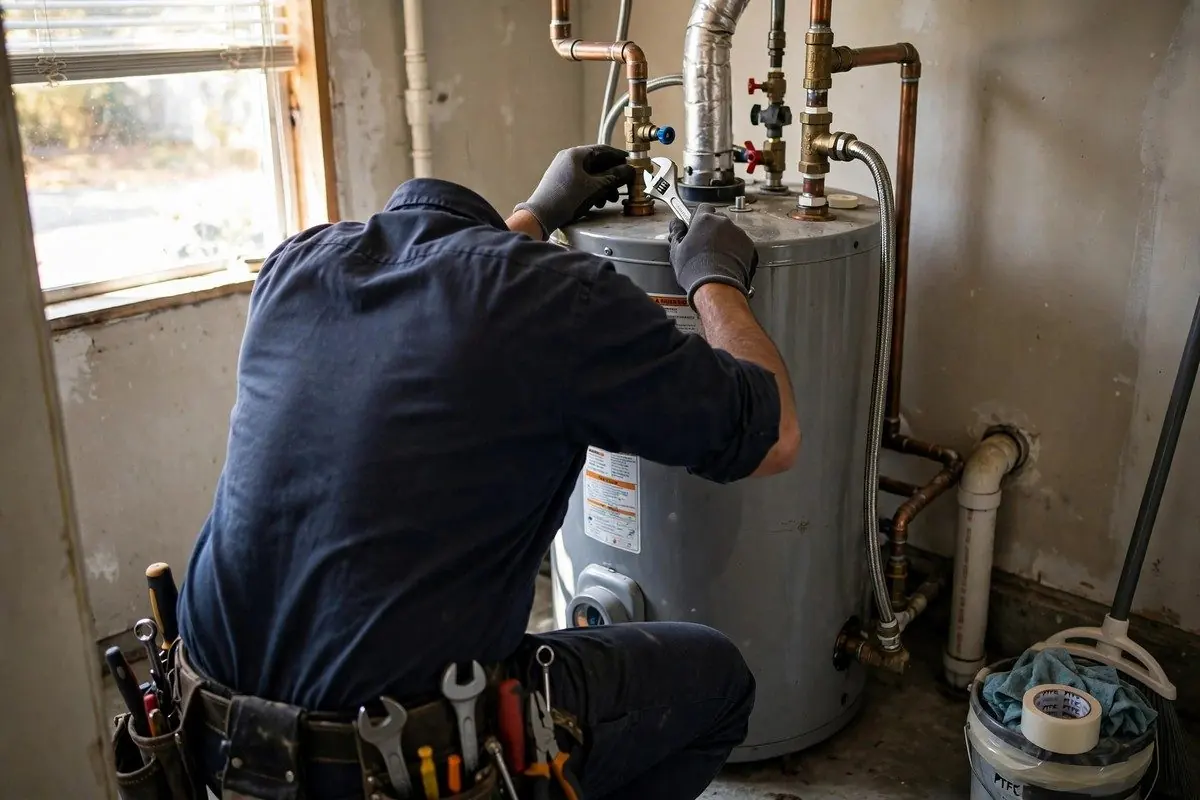
Water Heater Leaking or Smelling of Gas? Do This Now
Most heater faults can wait an hour while you gather information. A few cannot. Check which of these you are dealing with before you do anything else.
- If you smell gas, leave the building with everyone in it. Do not flip switches or use a phone inside. Call the gas utility or 911 from outside.
- If the tank is leaking, close the cold water valve on the pipe entering the top of the heater. That stops the refill.
- On an electric heater, turn off its breaker before you go near a wet floor. If the floor is flooded around the panel, stay out and call us and the electric utility.
- On a gas heater, turn the gas control knob to off. Leave the pilot relighting to a plumber.
- If the relief valve is spitting hot water or the tank is rumbling and banging, keep children and pets clear and call right away.
Tell the dispatcher the fuel type, whether water is on the floor, and what the tank label says. That lets us bring the right parts on the first trip.
Water Heater Faults We Fix
Most no-hot-water calls trace back to a short list of parts. Knowing the symptom narrows the list quickly.
Pilot that will not stay lit
A dirty pilot assembly or a worn thermocouple shuts the gas off by design. We clean or replace the part and test the flame.
Lukewarm or short hot water
On an electric tank, a failed heating element or thermostat is the usual cause. On gas, a weak burner or a thick layer of sediment is more likely.
Dripping from the relief valve
A weeping valve can mean a worn valve, high pressure, or a tank that is overheating. We find out which before replacing anything.
Leak at a fitting or valve
Loose connections, drain valves and supply nipples can often be repaired without touching the tank.
Rusty or smelly hot water
A spent anode rod lets the tank steel corrode, and bacteria can cause a rotten egg smell. We inspect the rod and flush the tank.
Banging and popping
Mineral sediment on the tank bottom traps steam bubbles that pop as they escape. Flushing helps, and heavy buildup may mean the tank is near the end.
What We See, What It Means, and What It Takes
Some faults are a part and an afternoon. Others tell us the tank has done its job. This table shows how we sort them.
| What you notice | Likely cause | Usual fix | Repair worth it? |
|---|---|---|---|
| No heat at all, electric. | Tripped high-limit, bad element or thermostat. | Reset and test, then replace the failed part. | Usually yes if the tank is dry inside. |
| Pilot out, gas. | Thermocouple or dirty pilot. | Clean or replace the part. | Usually yes |
| Water pooling under the tank. | Fitting, valve or a failed tank. | Trace the source with a dry towel and a light. | Yes for fittings, no for a tank seam. |
| Rust colored hot water only. | Anode rod spent or tank corroding. | Replace the rod if the tank is sound. | Depends on tank age. |
| Loud popping on every cycle. | Sediment layer | Flush, and check the burner or elements. | Often yes, if caught early. |
When a tank is leaking from the shell itself, repair is off the table and you are looking at water heater replacement. If you are weighing a bigger change, our tankless water heater page explains where that option fits.
How Hawthorne's Hard Water Shortens a Tank's Life
The Hawthorne Water Department draws only from groundwater, and its water quality report lists hardness of roughly 236 to 278 ppm at several plants. That is hard water. Heat drives the dissolved calcium out of solution, and it settles as scale on the tank bottom and on electric elements.
For you, that means two practical things. A heater that sits on a layer of scale burns more fuel to do the same job and runs hot at the bottom, which is when you hear the popping. It also means the anode rod gives up sooner than it would on soft water, so a yearly flush and an anode check are worth doing on any tank in the borough.
If your heater is already well past that stage, it is better to know now. A tank that has been scaled and corroded for years rarely recovers, and a repair bill on top of an aging shell is money you do not get back.
How a Repair Visit Goes
Make it safe
We confirm there is no gas leak, no live electrical contact with water, and no scald risk from the relief valve.
Diagnose by testing
We check the gas valve, burner, elements, thermostat, venting and the tank condition before we name a part.
Explain the choices
You hear what needs fixing, what it costs in plain terms, and whether replacement makes more sense.
Repair and test
We replace the part, restore the water and gas, and run the heater through a full cycle.
Leave it tidy
We check for leaks at every connection we touched and show you the shutoffs.
What Water Heater Repair Costs
We do not guess a number over the phone. Once we have tested the heater you get a clear price before work starts, and the decision to go ahead is yours.
If a sudden tank failure has damaged your home, ask your insurer what they need to see. We can describe the work in writing, and your insurer makes the coverage decision.
Older Hawthorne Homes and Their Water Heaters
Census estimates put the median Hawthorne home at 1953, and about 60 percent of the borough's housing units were built before 1960. Many of those homes keep the heater in a basement corner, sometimes beside an old chimney flue. A tank that has been moved or swapped over the decades can have mismatched venting, so we check draft and flue condition on every gas heater we repair.
About one housing unit in four sits in a two-unit building. If the heater serves both apartments, tell us on the call so we can warn the other household before the water goes off.
Serving Neighbors Outside Hawthorne
The same repair call comes in from towns on the Bergen side. Homeowners in Fair Lawn and nearby can reach the same 24/7 line, and a plumber is dispatched from our Wagaraw Road base.
Common Questions
Yes. Our line is open 24/7, including evenings, weekends and holidays. A leaking tank or a gas smell is treated as urgent at any hour, so call as soon as you notice it.
Yes, and close the cold water valve above it as well. For gas, turn the control knob to off. For electric, switch off the breaker first, and do not stand in standing water to do it.
On a gas or electric tank, a layer of sediment takes up space where hot water should be. A failed lower element on an electric heater does the same thing. Both are checked on a repair visit.
The pilot is designed to shut the gas off if it cannot stay lit. Do not keep relighting it. A plumber should check the thermocouple, the draft and the burner, because a poor draft can also be a carbon monoxide concern.
It depends on the fault and the tank. A bad thermostat on a sound tank is worth fixing. A tank that is leaking from the shell, or rusting inside, is usually better replaced.
It speeds up scale and anode wear. The borough's own report shows hardness of roughly 236 to 278 ppm at several plants. Flushing the tank each year and checking the anode rod are the simplest ways to slow the damage.
Local figures on this page come from the Hawthorne Water Department's 2026 Water Quality Report and U.S. Census Bureau American Community Survey estimates. Check current numbers with those sources before you rely on one.