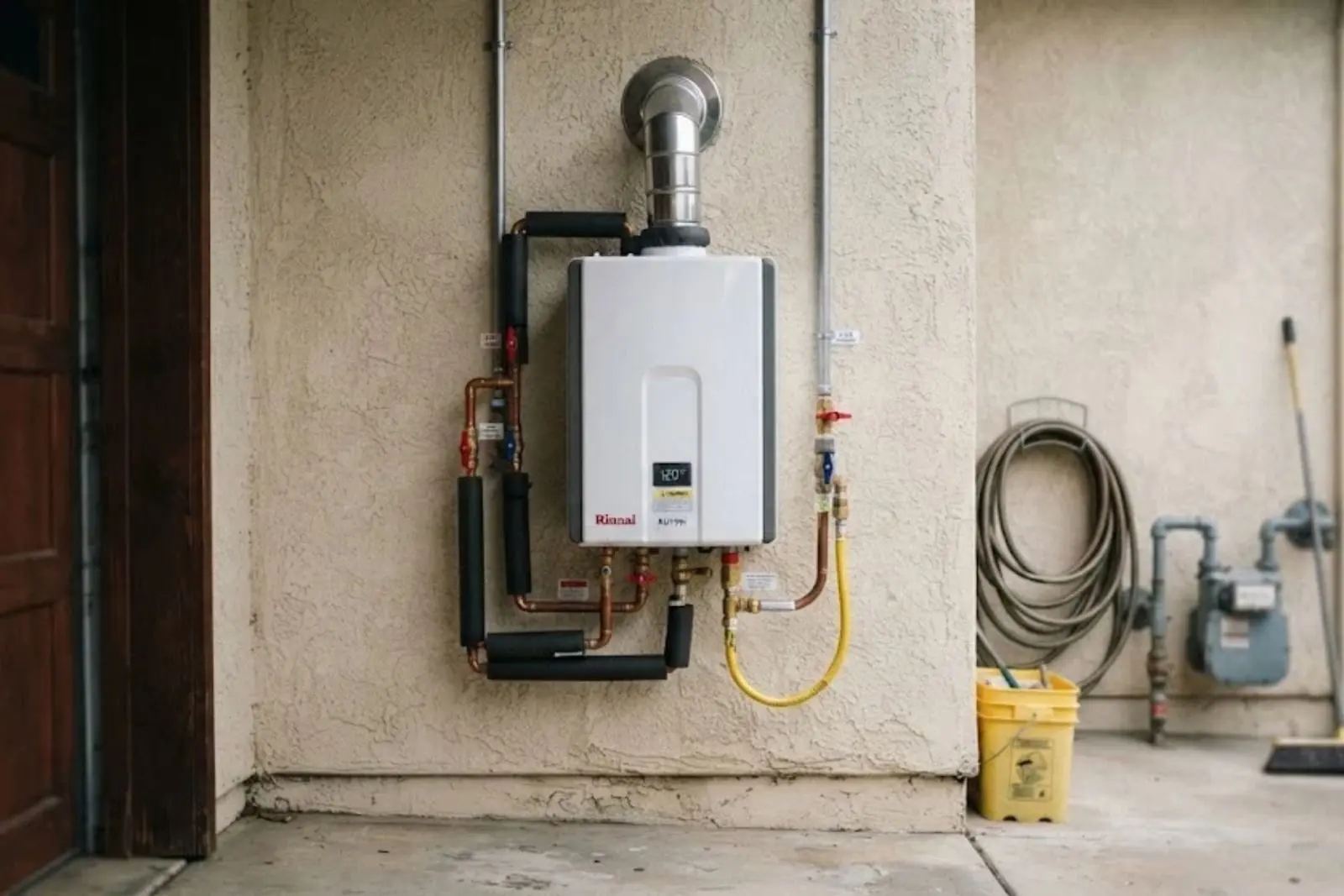
Is Tankless Right for Your House?
A tankless heater fires only when you open a tap. There is no standby loss, and the unit can last a long time with maintenance. It also costs more to install than a tank, and it needs the right gas, vent and water conditions to perform.
The honest answer depends on three things: your gas line capacity, your vent path, and how hard your water is. We check all three before we recommend anything.
Hard Water and Descaling in Hawthorne
The Hawthorne Water Department reports hardness of roughly 236 to 278 ppm at several plants. Scale forms on a tankless heat exchanger the same way it forms in a kettle. As the passages narrow, the unit throws error codes, heats unevenly and loses efficiency.
The fix is routine descaling. We close the isolation valves, circulate a descaling solution through the heat exchanger, then flush and test. In hard water, plan on doing this on a regular schedule, and ask us what schedule fits your usage.
A water softener helps, but the borough lists softeners among permit items, so ask the building department before you install one.
What a Tankless Install Needs
A tankless unit is not a drop-in swap for a tank. These are the items that decide whether it can go where you want it.
Gas line capacity
A tankless burner draws far more gas than a tank. Many older homes need a larger gas line or a new run from the meter.
Venting
Most units need sealed venting through a sidewall or roof, and condensing models also need a drain for acidic condensate.
Electrical outlet
Even gas units need a nearby outlet for the fan and controls.
Isolation valves
Service valves on the water lines are what make descaling possible. We install them every time.
Water supply
Low flow rates can keep a unit from firing. We check pressure and flow at the fixtures that matter.
Wall space
A wall mounted unit needs clearances for service and exhaust.
When Tankless Fits and When It Does Not
Tankless is a good tool for some homes and a poor one for others. This is how we sort the two.
Usually a good fit
- Smaller households that want steady hot water.
- Homes with a strong gas supply and a clear vent path.
- Basements or closets where a tank takes up space.
- Owners ready to descale on a schedule.
Usually not a good fit
- Houses with a small gas line and no easy way to upsize it.
- Homes where the vent run is long or blocked.
- Households that run many fixtures at once.
- Owners who will not maintain it in hard water.
Tankless and Tank Side by Side
Here is a plain look at where each type does well.
| Factor | Tankless | Tank |
|---|---|---|
| Hot water supply. | Continuous but limited by flow rate. | Limited by tank size, then recovery. |
| Space | Small wall unit. | Floor space for the tank. |
| Install demands | Gas line, vent and outlet upgrades often needed. | Simpler, usually uses existing hookups. |
| Hard water impact. | Needs regular descaling. | Needs flushing and anode checks. |
| Failure mode | Error codes and slow heating. | Leaks and no hot water. |
If you are weighing the two, our water heater installation page covers the tank side in detail. A tank that has already failed is a water heater replacement job.
How We Install a Tankless Unit
Survey the site
We check the gas line, vent path, water pressure, electrical outlet and mounting wall.
Install and vent
We mount the unit, run the gas and vent lines, and add isolation valves and a condensate drain if needed.
Commission and teach
We fire the unit, check combustion, set the temperature and show you how to read the display and flush it.
What Tankless Work Costs
A tankless install is a bigger project than a tank swap. After we survey the house you get a clear price before work starts, with gas and venting work spelled out.
For a planned upgrade, ask your gas or electric utility about rebates. We can provide a written scope of work for the application, and the utility decides eligibility.
Hawthorne Homes and Gas Lines
Census estimates put the median Hawthorne home at 1953, and about 60 percent of units predate 1960. Older houses were piped for a tank heater and a stove, not for a high-demand tankless burner, so the gas service and branch pipe size is the first thing we check. That is the single biggest cost question on a tankless job here.
The Hawthorne Building Department lists new water heaters among permit items, and a new gas line or vent adds to the scope. Ask the office how your job will be classified. Homeowners in Glen Rock ask the same question of their own construction office.
Common Questions
With hard water, more often than a manual suggests. The borough's report shows hardness of roughly 236 to 278 ppm at several plants. We recommend a regular flush schedule and can set one based on how much hot water you use.
Often it will not without an upgrade. Tankless burners use more gas at once than a tank burner. We measure the line and the meter capacity on the survey.
Usually not. Most units use sealed or direct venting through a wall or roof, and condensing models also need a condensate drain. We confirm the vent path before we quote.
Note the code, turn the unit off and on, and check that the gas and water valves are open. If the code returns, scale on the heat exchanger is a common cause. Call us for a descale or a service visit.
No. It depends on gas supply, vent path, water hardness and how many fixtures run at once. We will tell you honestly if a tank fits your house better.
Yes. We descale, diagnose faults and repair most common brands. Bring the model number and any error codes to the call.
Local figures on this page come from the Hawthorne Water Department's 2026 Water Quality Report and U.S. Census Bureau American Community Survey estimates. Check current numbers with those sources before you rely on one.