Choosing the Right Size and Type
The best size depends on how people in the house use hot water, not on square footage. Count the bathrooms, then ask how many showers, dishwasher cycles and laundry loads overlap in the busiest hour. That number is the first hour rating on the yellow label, and it matters more than the tank volume.
A tank that is too small runs out. One that is too large costs more to buy and to keep hot. We talk through your routines, then recommend gas, electric or heat pump based on the fuel you have and where the unit will sit.
What a Proper Installation Includes
Most installation problems come from skipped details. These are the pieces we put in every time.
Venting that matches the fuel
Gas heaters need a draft path or a direct vent that suits the unit. We check the chimney liner, pitch and connectors before we hook up.
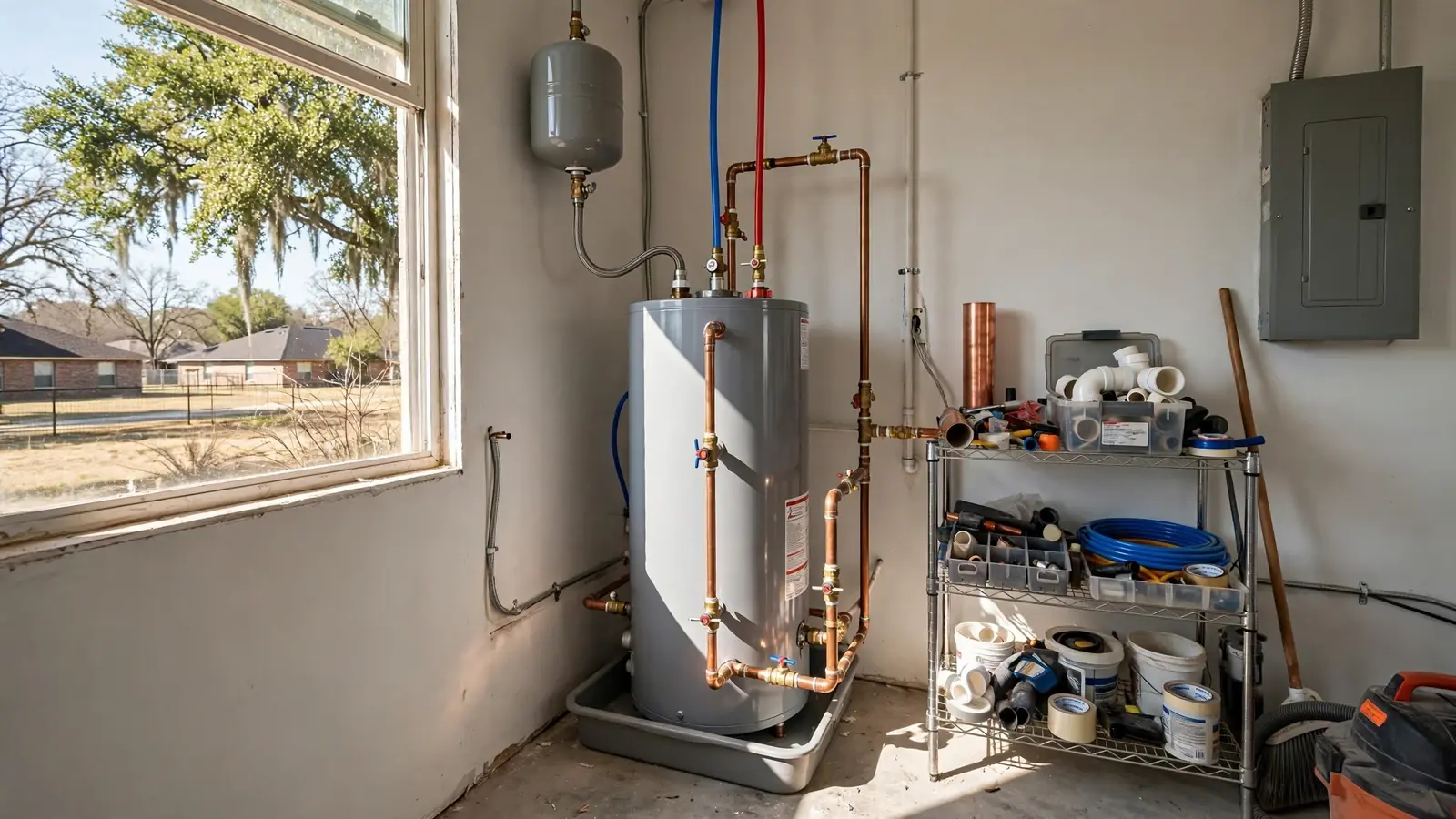
Expansion tank
A closed plumbing system has nowhere for heated water to expand. An expansion tank takes that pressure so fittings and the relief valve are not stressed.
Temperature and pressure relief valve
The relief valve gets a discharge pipe run to a safe point, never capped or reduced.
Drain pan and drain line
In a finished basement or on a floor above grade, a pan with a drain line limits the damage if the tank ever fails.
Shutoffs and unions
A shutoff valve and unions on the supply lines let the next person service the heater without cutting pipe.
Gas line and sediment trap
A gas heater needs a shutoff, a drip leg and a leak test at each joint.
How a New Install Goes
Plan the layout
We look at the location, the supply lines, the vent path and the electrical or gas feed.
Set and connect
We set the tank, connect water, gas or power, add the expansion tank and run the relief valve discharge.
Test and explain
We fire the heater, check for leaks and combustion safety, set the temperature and show you the shutoffs.
Moving a Water Heater: What Changes
Homeowners often want the heater out of the way when they finish a basement or redo a laundry room. Moving it is possible, but each change brings its own work.
| Change | What it involves | Watch for |
|---|---|---|
| Move within the basement. | New supply and return runs, possibly a new vent. | Vent length and pitch limits. |
| Gas to electric. | New circuit and removal of the flue. | Panel capacity |
| Electric to gas. | New gas line and a vent path. | Whether the chimney is usable. |
| Standard to heat pump. | Condensate drain and open air space. | Room volume and noise. |
| Tank to tankless. | Larger gas line or higher amperage, wall mount. | See our tankless page. |
If tankless is on your list, read our tankless water heater page for the hard water and gas line questions. For a failed tank that needs to go today, see water heater replacement.
Permits for a New Water Heater in Hawthorne
The Hawthorne Building Department issues plumbing permits under the NJ Uniform Construction Code. Its permit list names a new furnace, boiler or water heater, and it separately lists water softeners. The office is at 445 Lafayette Avenue, open weekday mornings and afternoons, and it issues no permits after 3 PM, so plan that into any timeline.
A new fuel type, a new location or a change in capacity is more than a like-for-like swap. Ask the building department how your job will be classified, and expect an inspection. Only a master plumber or an authorized contractor may do the plumbing, and you can check a licence with the state before you sign.
What Drives the Price of an Install
The unit is only part of the price. Venting, gas work, electrical work and permit time all change the total, so we look at the site before we give you a number.
For planned upgrades, ask your electric or gas utility whether it offers rebates on efficient models. We can provide a written scope of work for any application.
Plan for Hawthorne's Water From Day One
The borough's water report lists hardness of roughly 236 to 278 ppm at several plants. That means scale will form on any new tank or element. Specify a heater with a reachable drain valve, put a shutoff and unions on the supply, and plan a yearly flush so the investment lasts.
If you also want to treat the water at the source, ask about a softener. The borough lists water softeners among the work that needs a permit.
Installs Across the Area
Our crews work out of Wagaraw Road and go across the borough and the neighboring towns. Homeowners in Wyckoff can reach us at the same number, and Wyckoff's township office also requires a permit when you replace a hot water heater.
Common Questions
Start with the number of bathrooms and how many people use hot water at the same time. The first hour rating on the label tells you how much hot water the heater delivers in a busy hour. We help you match that to your household.
In most homes with a closed system, yes. The tank takes up pressure that builds when water heats and has nowhere to go. We check your existing pressure and system on the first visit.
Usually, yes. A move changes the supply lines, the venting and sometimes the gas or electrical feed. We walk the site first and explain what each option involves.
Yes. We handle the paperwork and schedule the inspection. The borough building department issues the permit and sets the process, so expect the office hours to shape the timeline.
It depends on what the house already has. If a gas line and a good vent path exist, gas is simplest. If the chimney is in poor shape or gas is not available, electric is usually easier to install.
Our line is open 24/7 and same-day appointments are offered when available. Tell us what works for you on the call and we will find the earliest suitable time.
Local figures on this page come from the Hawthorne Water Department's 2026 Water Quality Report and the New Jersey Uniform Construction Code (N.J.A.C. 5:23). Check current numbers with those sources before you rely on one.