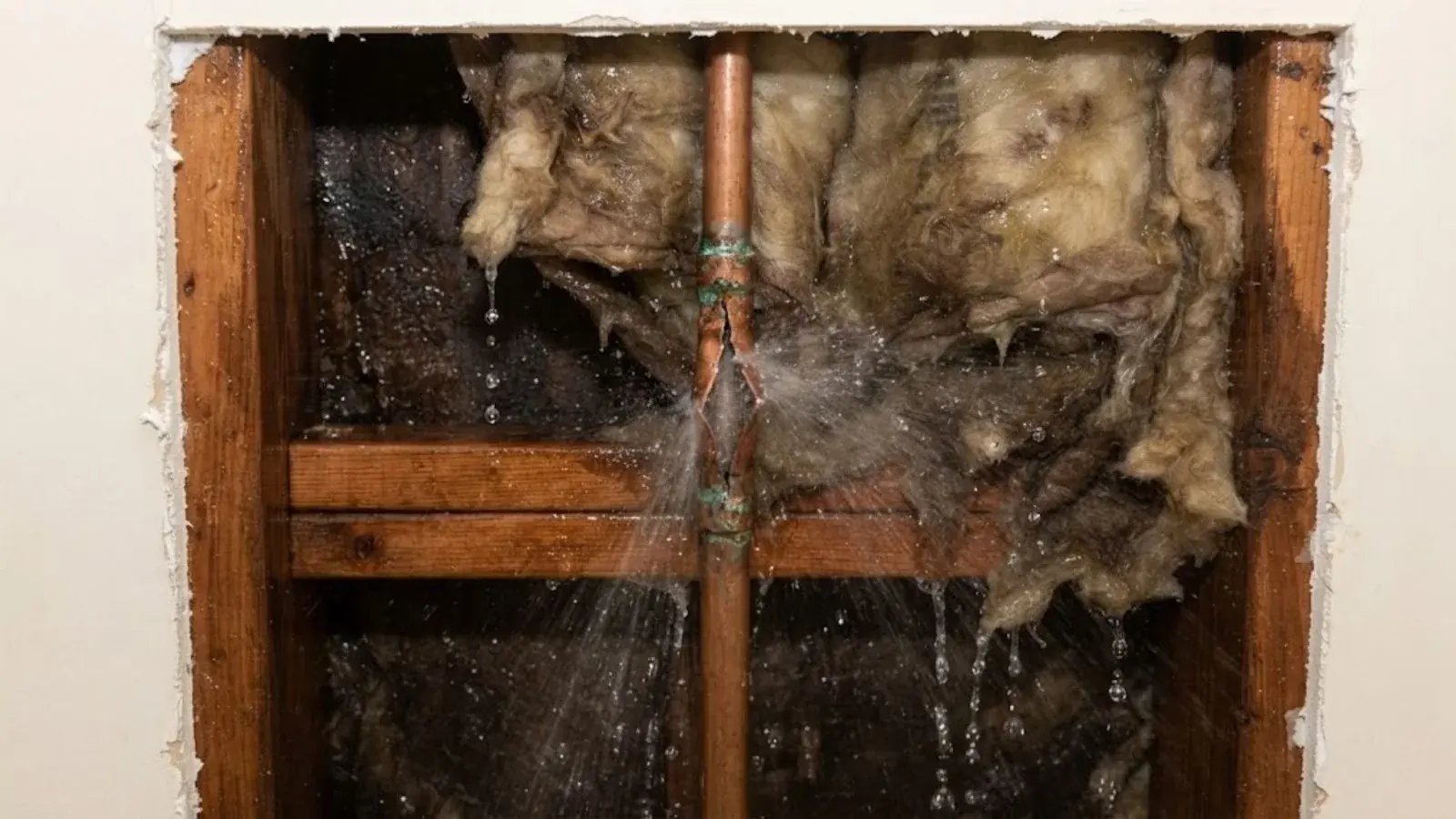
Shut-Off Steps for a Burst Pipe
Close the main shut-off
Turn the main valve clockwise until it stops. It is usually where the line enters near the meter, often in the basement.
Open faucets to drain
Open a cold tap on the lowest floor and one upstairs to relieve pressure and drain the pipes.
Cut power if safe
If water is near outlets or the panel, shut the breaker only if you can reach it dry. Otherwise leave and call 911.
Contain the water
Move belongings, use towels and buckets, and avoid stepping into rooms with a sagging ceiling.
Call the 24/7 line
Tell us where the pipe burst and whether the main is off.
What Makes a Pipe Burst
Pipes burst from freezing, corrosion, high pressure, physical damage and age. When water freezes, it expands, and the pressure builds between the ice and the closed faucet. The pipe often splits where the ice formed, but the leak only starts once the ice melts.
Corroded galvanized pipe fails differently. It thins from the inside until a weak spot blows out under normal pressure. This is common in older homes, and it often means other sections are weak too.
Where Bursts Show Up in Older Homes
Some places are more exposed than others. These are the usual locations for calls.
Exterior walls
Pipes near cold walls get less heat from the house and freeze first.
Unheated basements and crawlspaces
Cold air and drafts reach pipes close to sills and vents.
Hose bibs and outdoor lines
A hose left attached can trap water and split the pipe behind the wall.
Garages and attics
Supply lines in unheated spaces have little protection in a cold snap.
Old galvanized supply lines
Corroded sections burst under normal pressure with no freeze needed.
Frozen Pipes: Thawing Safely
A frozen pipe has not burst yet, but it may. Thawing it slowly and safely can prevent damage. Never use an open flame.
Safe ways to thaw
- Open the faucet so melting water can flow out.
- Use a hair dryer on low, working toward the frozen spot.
- Wrap the pipe with warm towels.
- Raise the heat in the room and open cabinet doors.
Never do this
- Torch, propane heater or any open flame.
- Heat gun on high or near plastic pipe.
- Walk away while the pipe is still frozen.
- Thaw a pipe that is already leaking without shutting the main.
When to Stop and Call Right Away
Some frozen pipe situations need a plumber, not a hair dryer. Call us at once if these apply.
- You cannot find which pipe is frozen.
- The frozen section is inside a wall or under a floor.
- You see a split, bulge or water as the pipe thaws.
- The pipe is near electrical wiring or the panel.
- No water comes out of any tap in the house.
Keep the main valve closed if you see any leak, and call the 24/7 line for guidance.
How We Repair a Burst Pipe
The repair depends on the pipe material, the location and how many sections are weak.
| Situation | Typical repair | What to expect | Follow-up |
|---|---|---|---|
| Single split in copper. | Cut out and replace the section. | Short job if the pipe is accessible. | Pressure test |
| Burst PEX or plastic. | Replace the damaged run with new fittings. | Often quick if the line is exposed. | Check for similar weak points. |
| Corroded galvanized | Replace the failed section or the line. | May expose more weak pipe. | Consider repiping |
| Pipe in a wall. | Open a small access, then repair. | Drywall repair is separate. | Dry the cavity. |
| Frozen but not split. | Thaw, inspect and insulate. | Check joints for hidden damage. | Add insulation or heat. |
If a burst reveals widespread corrosion, see our notes on repiping. To locate a slow leak behind a wall, see leak detection.
Hawthorne Storms, Cold and Pipe Failures
Hawthorne gets real winters. The borough's environmental inventory lists average snowfall of 30 to 40 inches a year, so a cold snap is a normal part of the year. If your pipes run along an exterior wall or through an unheated basement, insulating them before winter is a small job that can prevent a large one.
Storms add other risks. Sandy brought a 56 mph gust on October 29, 2012, and Elsa, Henri and Ida in 2021 brought flooding. After any storm that cuts power, check for water in the basement and for a failed sump or water heater before you restore power.
What Burst Pipe Repair Costs
We do not guess from a phone call. Once we see the break and the pipe, you get a clear price before work starts.
Burst pipe damage may be covered under your homeowner's policy. Ask your insurer what documentation they need. We can describe the work in writing, and coverage decisions belong to your insurer.
Reducing the Odds of a Next Time
Insulate exposed pipes, seal drafts near sills and keep cabinet doors open on cold nights. Disconnect hoses before winter and keep the heat on if you are away. Old galvanized lines may need replacement, and our water service line page covers the pipe from the street.
Burst Pipe Calls Across the Area
We dispatch from Hawthorne to nearby towns, including Fair Lawn. If a pipe bursts anywhere nearby, the 24/7 line is the fastest way to reach us.
Common Questions
Yes. Our line is open 24/7, including evenings, weekends and holidays. A burst pipe is an emergency at any hour.
It is usually in the basement near the front wall where the water line enters, close to the meter. Turn it clockwise to close. Find it before an emergency, and label it.
If the burst was on a hot line or the tank may run dry, yes. Turn the gas control to pilot or off, or switch off the electric heater breaker. Do not run the heater with an empty tank.
Often yes, if you use gentle heat like a hair dryer and keep a faucet open. Never use a flame. If the pipe is in a wall or leaks as it thaws, call us instead.
Look for wet or stained drywall, sound of running water with fixtures off, a meter that runs, or sudden loss of pressure. Shut the main valve and call us.
If we open a wall to reach the pipe, the opening needs patching afterward. We can tell you what is needed, and you can use your own finisher.
Local figures on this page come from the borough's Environmental Resource Inventory. Check current numbers with those sources before you rely on one.