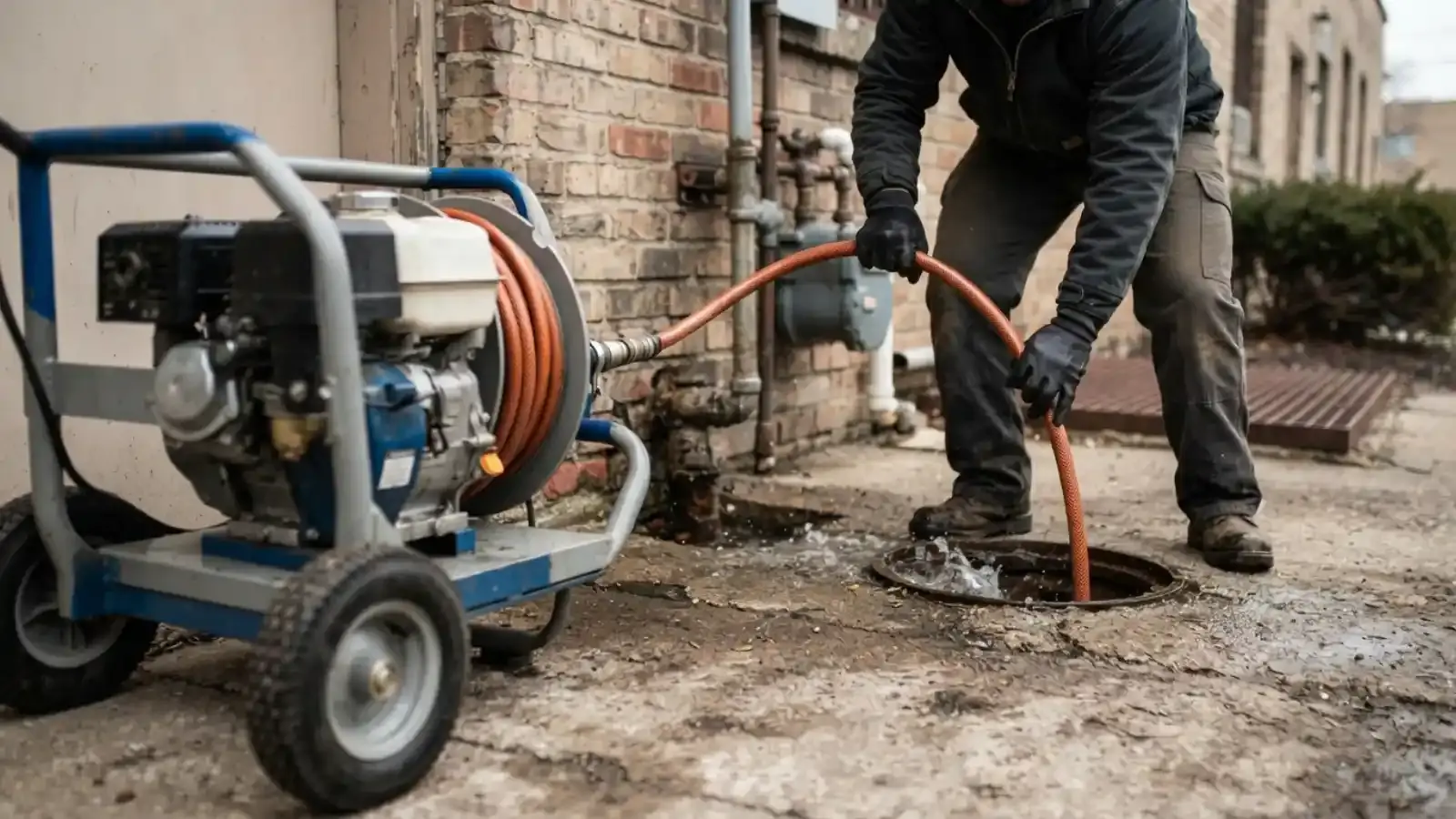
How Hydro Jetting Works
A hydro jetting machine pumps water through a long flexible hose to a nozzle at the end. The nozzle has jets pointing back and a few pointing forward. The rear jets pull the hose forward through the pipe and the forward jets break up the blockage.
As the hose is pulled back, the spray scours the pipe wall and pushes loosened debris down to the sewer main or out of a clean-out. The result is a pipe that is clean along its whole length, not just at the blockage.
A technician controls pressure and nozzle type to suit the pipe. A small sink line needs a gentle setup, while a four-inch main line can take a more powerful one.
Drain Cable or Hydro Jet: What Is the Difference
Both tools have a place. The choice depends on what is in the pipe and what condition the pipe is in.
Drain cable (snake)
- Opens a hole through the blockage, which restores flow quickly.
- Works well on a single soft clog in a short run.
- Can leave a layer of grease and scale on the wall.
- Roots can grow back soon after cutting.
Hydro jetting
- Scours the whole pipe wall, not just the clog.
- Clears grease, scale and fine roots from the line.
- Needs a sound pipe and a clean-out or access point.
- Often used for recurring blockages.
Main line draining slowly?
Describe the symptoms and we will tell you whether jetting, cabling or a camera check is the better first step.
When Hydro Jetting Makes Sense and When It Does Not
Jetting is useful, but it is not the answer to every sewer problem. This table shows where it fits.
| Condition | Hydro jetting a good fit | Notes |
|---|---|---|
| Grease buildup in a kitchen line. | Yes | Scours the wall where grease hardens. |
| Mineral scale on old pipe. | Often | Pipe must still be sound under the scale. |
| Fine tree roots at joints. | Often | Large root masses may need cutting first. |
| Recurring slow main line. | Yes | Camera check afterward is wise. |
| Collapsed or cracked pipe. | No | High pressure can worsen damage. |
| Badly offset joints or a belly. | Limited | Water will pool, repair is the real fix. |
The safest sequence is a camera look first, then jetting if the pipe can take it, then a second camera pass to confirm the result.
A Hydro Jetting Visit Step by Step
Most visits follow the same shape, even though the details change with the pipe.
Find the access point and look inside
The technician locates a clean-out, often in the basement or near the foundation. A camera shows pipe material, damage and the location of the blockage.
Run the jet through the line
The nozzle goes in, and the hose feeds forward slowly with water flowing. The technician pulls back and repeats until the water runs clear.
Verify with water and a second look
Water is run through the fixtures to test flow. A second camera pass shows the clean pipe wall and any damage that jetting uncovered.
Sewage Backup: What to Do Before the Jetter Arrives
If sewage is coming up through a floor drain or a toilet, treat it as a health hazard, not just a mess.
- Stop using every fixture, including laundry and the dishwasher.
- Keep people and pets out of the wet area and wear boots and gloves if you must enter.
- Do not touch electrical items in standing water. If water is near the panel, stay out and call the utility.
- If you smell gas or see water around a boiler or water heater, leave the building and call the gas utility or 911 from outside.
- Do not pour chemical drain cleaner into a backed-up line.
Hydro jetting is a cleaning tool, so a plumber will often want a quick cable or a camera look first to decide if jetting is safe for the pipe.
What Hydro Jetting Cannot Do
Jetting cleans, it does not repair. A pipe with a crack, a collapse or a sag will still have that defect after a perfect cleaning. A line that clogs again soon after jetting points to damage, not dirt.
Very old clay or brittle cast iron may not tolerate pressure, and a good technician will say so rather than push ahead. If the camera shows damage, the better question becomes repair or replacement.
Ask what pressure and nozzle will be used, whether a camera pass is included, and what happens if the camera finds a problem. A clear answer to all three is a good sign.
Why Hydro Jetting Questions Come Up in Hawthorne
The borough's housing stock is older than most of North Jersey. Census estimates put the median home at 1953 and about 60 percent of units before 1960. Many of those homes still have clay or cast iron sewer laterals, and the wear on those pipes decides whether jetting is safe. Ask for a camera look before agreeing to high-pressure work.
Hawthorne is a lessee municipality of the Passaic Valley Sewerage Commission in Newark, and the borough requires a Sewer Connection Permit through Public Works for connections. That matters if your line problem leads to a repair that touches the connection. Call Public Works before digging.
Storms are another factor. Tropical Storm Henri on August 22, 2021 flooded stretches of Lafayette Avenue, Rea Avenue and Wagaraw Road, and Ida added 6.28 inches of rain on September 1, 2021. If your main line backs up only in heavy rain, jetting may clear the line but not the cause. Tell the plumber when your backups happen.
What Affects the Price of Jetting
Price depends on access, pipe length and size, how heavy the buildup is, and whether camera work is included. A line with a clean-out near the foundation is faster to reach than one with no access point. Night and holiday calls carry an after-hours call-out.
Ask for a clear price before work starts. Any honest plumber can explain what is included and what would change the figure, such as finding a collapse partway down the line.
For a closer look at the service, see our hydro jetting page. If you want a longer-term maintenance plan or a one-time cleanup of a stubborn main, our sewer line cleaning service covers it.
Keeping a Cleaned Line Clean
Keep grease out of the kitchen sink. Pour cooking fat into a can and put it in the trash once it sets. Paper towels, wipes and feminine products do not belong in a toilet.
If your yard has large trees near the sewer path, expect roots to be a recurring issue. Some homeowners schedule a camera check every year or two to see how fast roots return. That interval is a decision for you and the plumber based on what the camera shows.
Neighbors in Ridgewood and Wyckoff ask the same questions about older lines, and the answers are the same.
Common Questions
It is a pipe cleaning method that sends high-pressure water through a hose to scour the inside of a sewer line. The water breaks up grease, scale and soft roots and carries them away. It cleans the whole pipe wall instead of only opening a hole.
It depends on the condition of the pipe. Sound cast iron, PVC and clay can often take it, while cracked, collapsed or very brittle pipe may be damaged. A camera inspection first is the safest way to decide.
A snake or cable pushes a cutting head through a clog and opens a channel. Jetting uses water pressure to clean the full diameter of the pipe. Jetting tends to last longer on grease and scale, while a cable is fine for a simple clog.
There is no fixed schedule. Lines with a history of roots or grease may need cleaning on a regular cycle, and lines that never clog may never need it. A camera check shows how quickly buildup returns, and that guides the interval.
No. Jetting cleans debris and does not repair structural damage. A camera showing a collapse or a break points to repair or replacement, and the plumber should explain those options.
The borough is a lessee of the Passaic Valley Sewerage Commission, and a Borough Sewer Connection Permit comes through Public Works. Cleaning does not usually involve a permit, but a repair that alters the connection may. Ask Public Works or your plumber before any digging starts.
Local figures on this page come from the borough's Environmental Resource Inventory, U.S. Census Bureau American Community Survey estimates and the Passaic Valley Sewerage Commission. Check current numbers with those sources before you rely on one.