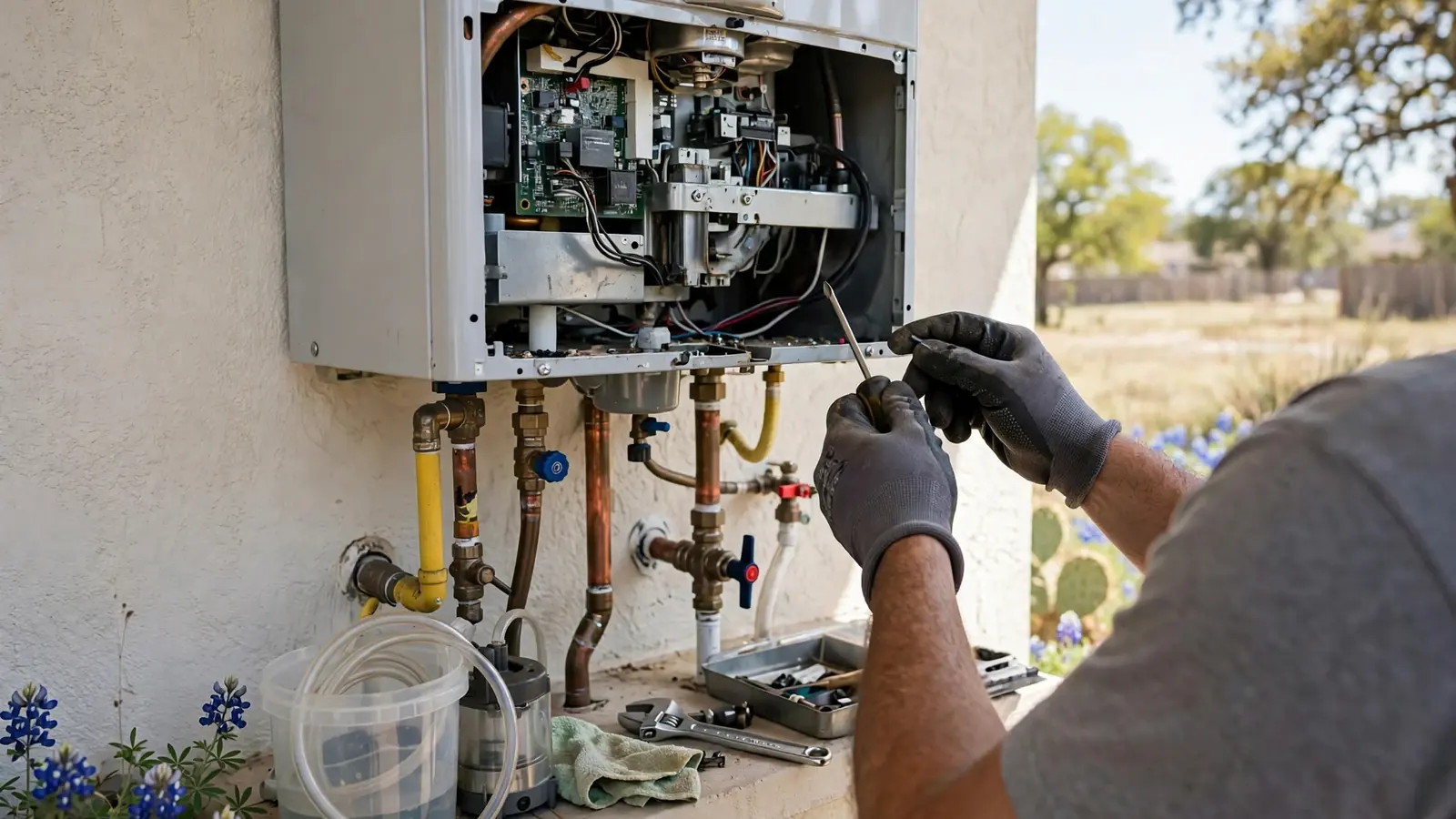
What a Tankless Installation Actually Requires
A gas tankless unit needs a gas line large enough to feed it at full fire, a sealed vent run to the outside, a nearby electrical outlet, and water plumbing that can handle the flow. An electric tankless unit skips the gas and the vent but demands a heavy dedicated circuit instead. Either way, the unit should be sized to the number of fixtures that run at once, not to the size of the house.
Plan for a half day to a full day of work in a house where the piping is easy to reach. Older houses often add time because the gas line, the vent path or the panel needs changes before the new unit can hang on the wall.
Gas and Electric Tankless Units Compared
The fuel you choose changes almost every other requirement. This table shows where the two types differ so you can see which upgrades your house is likely to need.
| Requirement | Gas tankless | Electric tankless |
|---|---|---|
| Fuel supply | Gas line sized for the unit's full input, often larger than the old tank needed. | None, but a heavy dedicated circuit from the panel. |
| Venting | Sealed vent to the outside, with a separate intake on many models. | No vent needed. |
| Condensate | High efficiency models make acidic condensate that needs a drain and sometimes a neutralizer. | None |
| Electrical | A standard outlet for controls and the fan. | The main load, and the panel must have room for it. |
| Best fit | Houses with an existing gas service and a wall near an exterior side. | Small households, apartments or homes without gas. |
| Main risk | Undersized gas pipe starves the burner and the unit shuts down. | Panel capacity runs out before the unit is powered. |
For a broader look at what the work involves from start to finish, see our tankless water heater service page.
Thinking about going tankless?
Call and tell us about your home. We will explain what the install would involve before any work starts.
Gas Line: Why the Old Pipe Is Often Too Small
A tank water heater burns gas slowly over a long time. A tankless unit fires hard the moment you open a tap, so it needs a lot of gas at once. If the pipe feeding it was sized for an old tank, the burner can starve at high flow and the unit will cut out or run cold.
An installer checks the unit's input rating, the length of the run from the meter and every fitting along the way. Sometimes the answer is a larger pipe for the last stretch. Sometimes the meter or regulator is the limit, and that is a conversation with the gas utility, not something a plumber can change alone.
Gas work comes with a hard safety line. If you smell gas at any point, leave the building right away, do not touch switches or lighters, and call the gas utility or 911 from outside. Never try to tighten a gas fitting yourself.
Venting: The Part That Decides Where the Unit Can Go
Gas tankless units push hot exhaust through a sealed vent, usually plastic or stainless depending on the model. The vent must run to the outside with a continuous pitch, and the manufacturer sets a maximum length and a limit on elbows. Every elbow counts as extra length, so a unit far from an exterior wall may not be allowed at all.
This is why the existing tank location is not always the right spot for the new heater. A basement corner with no nearby exterior wall may force a long vent run, while a spot near a side wall is simple. The vent termination also has to sit clear of windows, doors and air intakes, and in snow country it should stay above where drifts build.
Carbon monoxide is the safety issue here. A new gas appliance should be paired with working carbon monoxide alarms on each level, and you should test them after the install. If an alarm sounds, get everyone outside and call 911 before anything else.
A tankless heat exchanger has narrow passages, and mineral scale narrows them further. Scale cuts flow, raises the temperature the unit must reach and shortens its life. Hard water does this to any heater, but a tankless unit has less room to tolerate it than a tank does.
Ask the installer how the unit will be flushed and whether isolation valves go in on the hot and cold lines. Those valves let you descale it with a pump and vinegar or a cleaning solution without taking it off the wall. A whole-house softener or a scale filter upstream is the other option, and it protects faucets and appliances too.
What Hawthorne Water and Permits Mean for Your Tankless Install
The Hawthorne Water Department draws groundwater from wells, and its own water quality report lists hardness of roughly 236 to 278 ppm at several plants. By our rough conversion that is about 14 to 16 grains per gallon, which is hard enough to scale a heat exchanger in a few years without care. If you are choosing a tankless unit here, budget for flush valves and a descaling routine, and ask about a softener.
A new water heater or a water softener appears on the borough's list of work that needs a permit, issued through the Borough Building Department at 445 Lafayette Avenue under the New Jersey Uniform Construction Code. The state treats a like-capacity replacement as minor work, but a gas tankless conversion often changes the gas line and vent, so ask the installer who is pulling the permit and when the inspection happens. Check the installer's state licence before signing.
Questions to Ask Any Installer
A good proposal answers these without being asked. If it does not, ask.
- What is the unit's gas input, and will the existing gas pipe supply it at full fire?
- Where will the vent exit, how long is the run, and how many elbows does it use?
- Does the unit make condensate, and where does it drain?
- Are isolation valves for flushing included?
- Who pulls the permit, and when is the inspection?
- What happens to the old tank and the old vent?
Write down the answers and compare them across proposals. A price that leaves out the vent or the gas pipe is not a full price.
Electrical Needs and Water Safety
Gas units still need power for the fan, the controls and the ignition. A grounded outlet within reach is the usual requirement, and a surge protector is often recommended. Electric units are the heavy users, drawing a large dedicated circuit that many older panels cannot spare.
Electrical work near water has its own rules. Turn the breaker off before anyone works on a water heater, and keep the area dry. If water is standing around the panel or the unit, do not step in it and do not touch the equipment. Shut off power at the main if you can reach it safely, or call the electric utility.
How the Install Day Usually Runs
Shut down and remove
The water, gas and power are shut off and the old heater is drained and taken out.
Mount, connect and test
The new unit is mounted and connected to the gas line, vent, water lines and drain. Gas joints are leak tested and flow is checked at the fixtures.
Walk through
You are shown the shutoffs, the flush valves and the error code display.
Getting Help with the Install
If you are weighing a tankless install against a standard tank, our water heater installation team can compare the two on your actual house. We also work across the border in Fair Lawn, where the water and the housing are different, so the sizing can differ too. Call the 24/7 line to talk through your setup.
Common Questions
Usually yes, but not as a straight swap. The gas line, the vent and the water lines all need to be checked first. Many homes need at least one upgrade.
Gas units do. They use a sealed vent made for the unit, with a length limit set by the manufacturer. The old chimney or flue is often not suitable on its own.
Scale can build up inside the heat exchanger and reduce flow and efficiency. Regular flushing through isolation valves and a softener or scale filter slow the problem. Ask your installer to set up the flush valves at install time.
Water heater work is on many boroughs' permit lists, and the work must follow the state's rules. Ask your installer whether a permit is needed and who pulls it. They should be able to tell you before work starts.
It can be, if the number of fixtures running at once is low and the gas supply is adequate. A sizing check against your peak use is the honest way to decide. A tank can still be the better answer for some households.
It changes how you maintain the unit more than which one you buy. With hardness near 236 to 278 ppm at several borough plants, plan on isolation valves, a flush every year or so and a conversation about softening. Ask the installer how the unit's manufacturer treats scale in the warranty terms.
Local figures on this page come from the Hawthorne Water Department's 2026 Water Quality Report and the New Jersey Uniform Construction Code (N.J.A.C. 5:23). Check current numbers with those sources before you rely on one.